AI Agency Ladder: five levels of agency with AI, from individual curiosity to organizational infrastructure
L1 Curiosity · L2 Individual fluency · L3 Team workflows · L4 Departmental skills · L5 Organizational infrastructure
AI Agency Ladder is the SkilLab AI framework of five levels for diagnosing and developing AI agency — from the curious individual explorer to the enterprise with AI as an operational infrastructure layer.
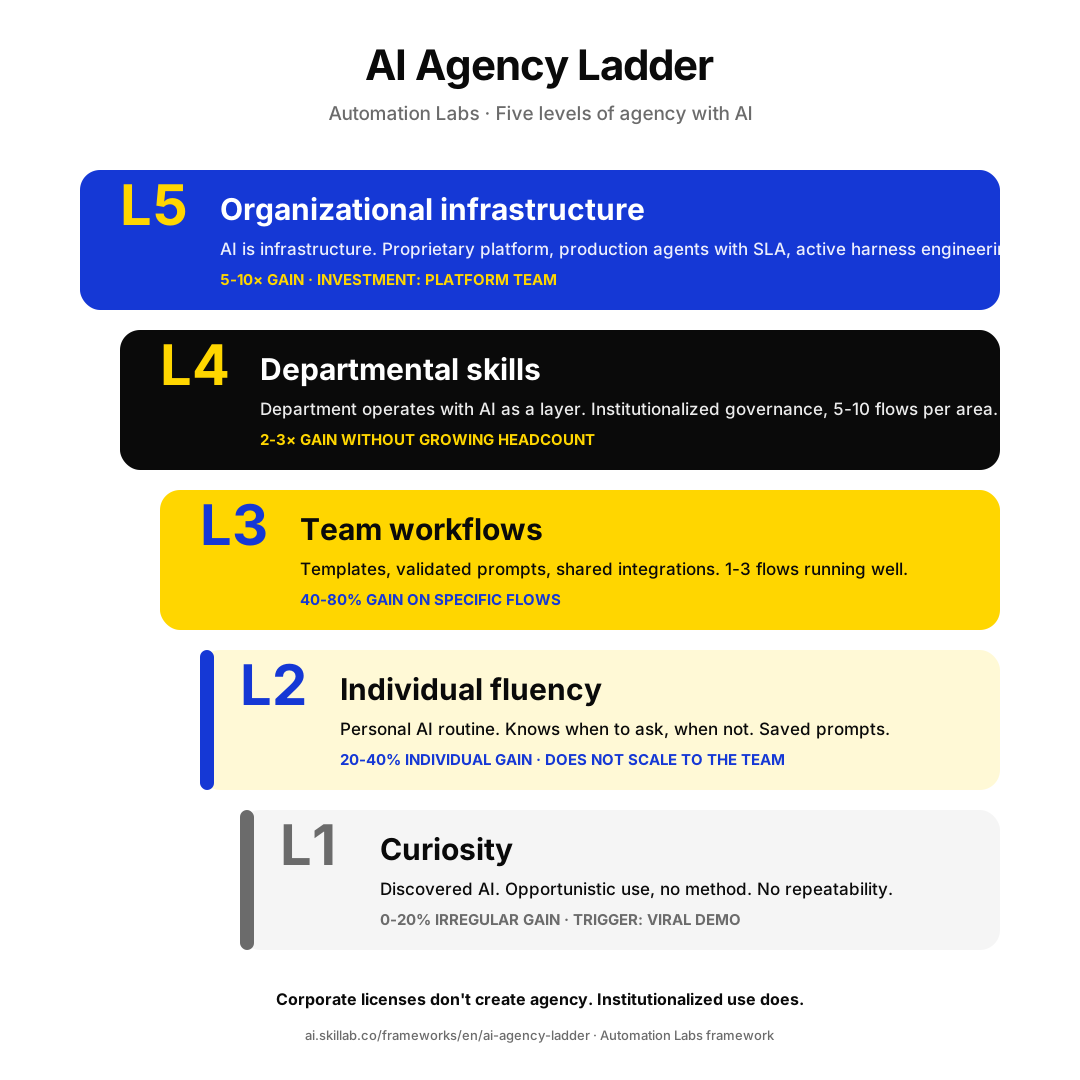
The five levels
L1 · Curiosity. The person or team has discovered AI and is experimenting. Opportunistic use, no method. Visible results in individual productivity: 10-20% on the best day, 0% on the worst. No repeatability, no documentation. Trigger is typically a viral demo or a coworker who showed Claude/Copilot working.
L2 · Individual fluency. The person has a personal AI routine: knows when to ask, when not to ask, has saved prompts, knows the limits of the model they use. Stable productivity gain of 20-40% on cognitive tasks. What’s missing: the gain belongs to them, not the team. When they’re on vacation, the team reverts to baseline.
L3 · Team workflows. The team has shared AI workflows: templates, validated prompts, integrations with existing tools (Notion, Slack, n8n). Productivity gain no longer depends on who’s online. 40-80% gain on specific flows (support, writing, data analysis). Typically 1-3 flows running well.
L4 · Departmental skills. The entire department operates with AI as a capability layer. Sales, marketing, legal, HR, finance — each has 5-10 institutionalized flows. There is a governance pattern (who approves a new prompt, who reviews critical output, how impact is measured). 2-3× gain in output capacity without proportional headcount growth.
L5 · Organizational infrastructure. AI is company infrastructure, like the ERP or the CRM. There is a proprietary orchestration platform (n8n, Cowork, or internal stack), agents operating in production with SLA, active harness engineering, institutionalized quality and safety metrics. 5-10× gain in operating capacity. Investment equivalent to an internal platform team (5-15 people).
How to apply the diagnostic
Use AI Agency Ladder as an interview instrument, not a self-report. Ask four people in the company at distinct hierarchical levels: “tell me how you used AI last week.” L1 gives a single, out-of-context example. L2 lists three to five stable applications and names the tools used. L3 mentions the team and names a recurring flow. L4 talks in departmental metrics. L5 cites governance, harness, or an internal product.
The common error is confusing L2 with L4 because the company bought corporate Copilot licenses. Licenses don’t create agency — institutionalized use does.
Related posts
- AI Agency Ladder: the 5 levels explained — extended version with diagnostics.
- Harness Stack — what lives inside L5.
- Agent Trust Stack — for teams moving from L3 to L4.
When to use
- Initial AI maturity diagnostic before buying training or consulting.
- Briefing for a corporate AI capability program.
- AI adoption roadmap in an organization with more than 50 employees.
When NOT to use
- Small, homogeneous team — the ladder assumes role diversity.
- Isolated tactical decision (which tool to buy) — use Agent Trust Stack.